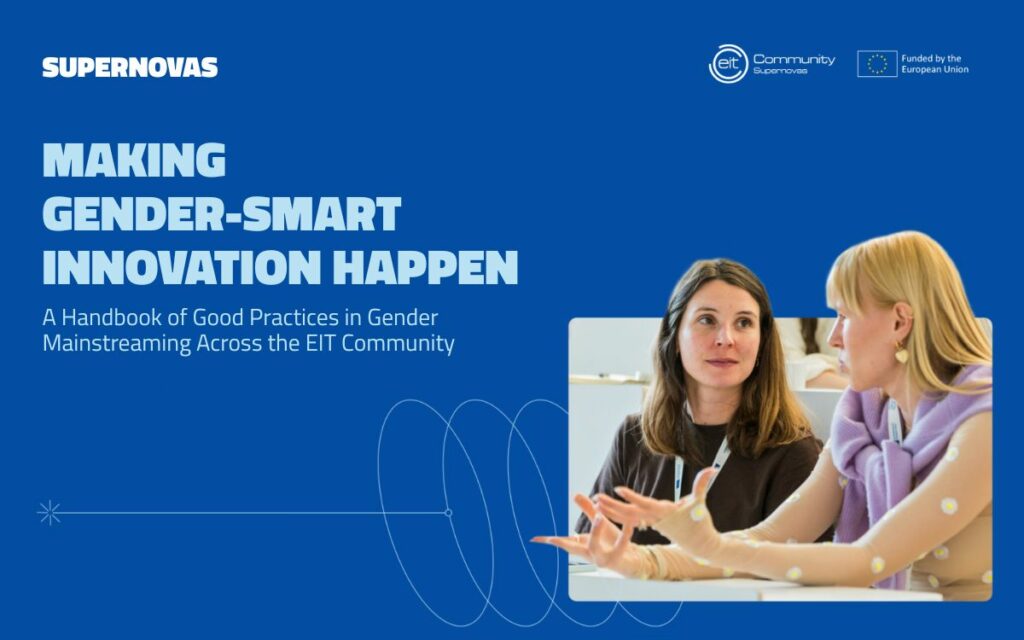
EIT Community Supernovas, an initiative funded by the European Institute of Innovation and Technology (EIT), a body of the European Union, has launched Making Gender-Smart Innovation Happen: A Handbook of Good Practices in Gender Mainstreaming Across the EIT Community.
Released during European Diversity Month 2026, the handbook brings together practical initiatives implemented across the EIT Community between 2022 and 2025, demonstrating how gender equality can strengthen innovation performance, competitiveness and societal impact across Europe.
Designed as a practical handbook for organisations, policymakers and ecosystem builders, the publication showcases tested approaches that can be adapted and replicated across innovation ecosystems. From inclusive deep-tech training and mentorship programmes to gender-responsive innovation calls and entrepreneurship support, it provides concrete examples of how to embed gender-smart innovation across education, research and business creation.
The economic case for gender-smart innovation
The publication highlights the broader economic benefits associated with advancing gender equality. According to the European Institute for Gender Equality (EIGE), improving gender equality could increase EU GDP per capita by between 6.1% and 9.6% by 2050, equivalent to between €1.95 trillion and €3.15 trillion. The handbook connects these wider societal and economic gains to the importance of strengthening women’s participation, leadership and visibility across Europe’s innovation ecosystem.
The handbook also highlights growing momentum among women-led innovation ventures across Europe, pointing to substantial untapped innovation potential and opportunities to strengthen women’s participation in the innovation economy.
Proven initiatives with measurable impact
The handbook is more than a policy argument; it is a record of what works.
The initiatives featured in the handbook go beyond participation targets. They showcase practical approaches already being implemented across Europe, from gender-responsive innovation calls and inclusive deep-tech training to mentorship programmes, leadership development, gender-balanced expert representation and entrepreneurship support tailored to women innovators.
Together, they illustrate how gender mainstreaming can be embedded across the full innovation pipeline, from education and research to start-up acceleration and investment readiness.
Among the initiatives showcased:
- Girls Go STEM has trained more than 100,000 students across Europe, with girls representing 86% of participants, helping strengthen the pipeline of women entering STEM and innovation careers.
- EIT Deep Tech Talent Initiative surpassed its targets, reaching 36% women learners and training one million deep-tech talents by 2025.
- WE Lead Food supported more than 600 women professionals across 60+ countries to strengthen women’s leadership in agrifood innovation.
These programmes demonstrate that inclusion and excellence reinforce one another, while scalable and replicable models already exist.
Furthermore, the EIT’s leadership in this space has not gone unnoticed. In both 2023 and 2025, the EIT received the EU Agencies Network (EUAN) Diversity & Inclusion Award, recognising its sustained commitment to advancing inclusion across Europe’s innovation ecosystem.
A strategic roadmap for Europe’s future
The handbook positions gender-smart innovation as a strategic pillar for Europe’s long-term competitiveness. Regions with higher levels of gender equality consistently rank among Europe’s most innovative, highlighting the strong connection between inclusion, talent diversity and innovation performance.
As Europe faces mounting pressures to strengthen its global standing in deep tech, entrepreneurship and sustainable industry, the message of this handbook is unambiguous: inclusion is not a trade-off with excellence. It is a prerequisite for it.
The report is now available for download.
Acknowledgements
We thank all the participants from the EIT Knowledge and Innovation Communities (KICs) who took part in the Gender Mainstreaming Good Practices Workshops and contributed with collaborative spirit to validating and enriching the practice descriptions through dialogue and peer learning.
A special appreciation goes to Magdalena Gryszko-Szanto, EIT Gender Equality Lead, for her continuous support, guidance and inspiration throughout the process. Additionally, we would like to express our sincere gratitude to the report’s lead author, Anna Lucia Pinto, Gender, Diversity, and Inclusion Expert, for the outstanding contribution.
We further recognise the many KIC teams and practitioners engaged in implementing gender mainstreaming across the EIT Community for their ongoing efforts to make gender equality an integral part of Europe’s innovation ecosystem.
Related resources
Gender Bias in European Venture Capital report
Women2Invest programme